









































– Header title (max. 81 characters)



These refrigerants are usually chemical compound gases. For each air conditioner, the choice of refrigerant is made based on multiple criteria such as following ones:
- Thermal efficierncy: the capacity of the refrigerant to absorb and release it as it compresses and expands. This performance depends on the indoor/outdoor temperature and many other factors. The more efficient, the more energy-saving for the AC equipment.
- Safety and refrigerant charge: Refrigerants vary in toxicity level and flammability level, which may cause more hazard when the AC system requires a higher charge of refrigerant.
- Environmental impact: measured with Global Warming Potential (GWP) and ODP (Ozone Depleting Potential)
- Other technical considerations, such as the working pressure and ease of maintenance
"The choice of refrigerant is based on many factors and depends on each case” explains Tak Fujii, Vice President, Enterprise Strategy, Product Management and Aftermarket. “There’s no one perfect solution suited for all HVAC systems, so we investigate the most suitable option for each product”



R32: a refrigerant type with lower impact on the global warming
Since then, the HVAC industry has been looking for more environmentally friendly refrigerant alternatives. The Kigali Amendment to the Montreal Protocol, signed in 2016, determined that phasing down HFC gases – which are used in air conditioning – could contribute to saving 0.50˚C of climate change.
Replacing R410A with R32 refrigerant is one option in line with this protocol and enables significant reductions in CO2 -eq emissions. R32’s impact on global warming is 3 times less than that of R410A.
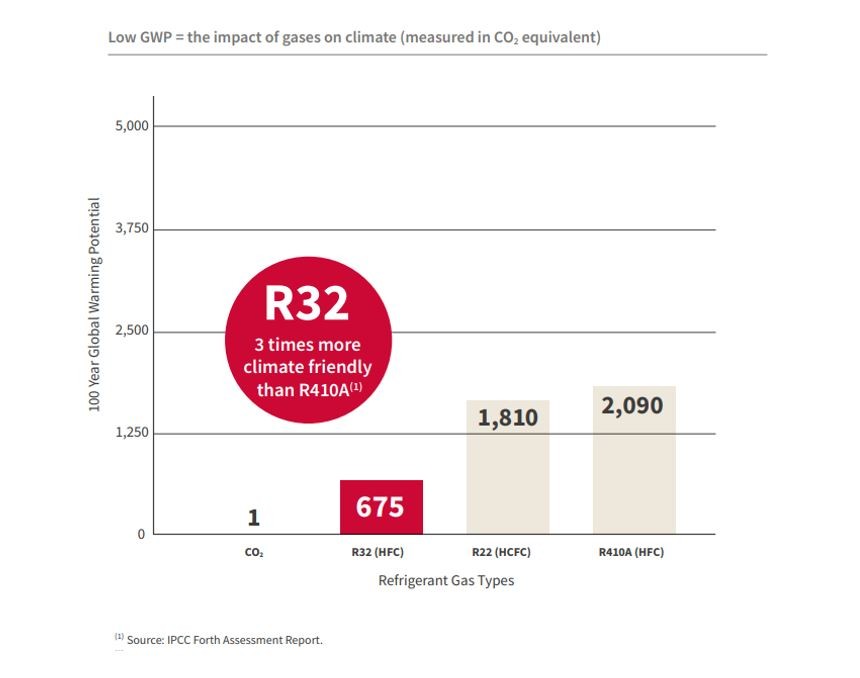
R32 refrigerant’s physical properties make it a suitable alternative to R410A gas for residential air conditioners, both cooling and heating.
Excellent energy efficiency: R32, amongst other benefits, presents a higher thermal conductivity than R410A leading to better heat transfer. Using R32 contributes to the high energy efficiency of Hitachi air conditioners.
Less refrigerant charge: With a higher volumetric capacity, and a lower liquid density, R32 can achieve cooling performance with less refrigerant (about 12% charge reduction compared to R410A)(2).
Class A / lower toxicity R32 belongs to the lower toxicity class, like R410A, R22 or R744 (CO2).
Class 2L / mild flammability R32, even though flammable, can be used safely when complying with industry standards and safety regulation.(5) the reduction of direct CO2-eq emissions.